Wednesday, April 11, 2018

Sejak dulu, PRM menghebohkan kelemahan Pakatan ...?- lihat kenyataan 2015?

Tindakan PRM bertanding PRU14 bukan sesuatu yang 'last minute' ...kerana jika dipantau kembali kenyataan dan pendirian PRM(sedih sekali pihak media massa tidak melapurkan kebanyakkan kenyataan PRM), sebagai contoh kenyataan yang dikeluarkan pada bulan September 2015.
 
Di dalam kenyataan ini, PRM juga menhebohkan kelemahan Pakatan Rakyat.... sila baca..

Satu masalah dengan Pakatan Rakyat(dan kini Pakatan Harapan) adalah sikap 'eksklusif' - tidak ingin parti lain masuk berjuang bersama menentang UMNO-BN. Untuk 2 PRU yang lalu, banyak parti pembangkang membuat pilihan untuk tidak bertanding - khususnya untuk membenarkan PR lawan satu lawan satu dengan UMNO-BN...tetapi dalam PRU14, banyak parti mungkin akan menampilkan diri memberikan rakyat alternatif atu pilihan lebih...

Akan kita hebohkan lagi kenyataan dan tindakan PRM lalu ini...


Kenyataan Media – 28/9/2015
PRM harapkan semua parti pembangkang bekerjasama menentang BN dalam PRU 14
Parti Rakyat Malaysia(PRM) berpendirian bahawa bilangan rakyat Malaysia yang menolak Barisan Nasional(BN) yang dipimpin UMNO kini sudah bertambah, oleh itu perlu sangat parti-parti politik pembangkang  bersatu menghadapi Pilihanraya Umum ke-14 (PRU 14) menentang Barisan Nasional.
Adalah benar, setiap parti politik mempunyai pendirian dan ideologi berlainan mengenai beberapa isu yang menjejaskan negara, tetapi PRM percaya bahawa semua parti politik sanggup berkerjasama dengan niat sama mengalahkan parti-parti Barisan Nasional (atau gagasan parti-parti politik di bawah pengaruh UMNO), yang telah memerintah Malaysia sejak kemerdekaan pada 1957.
Tidak boleh dinafikan bahawa kerajaan BN dahulu ada melakukan perkara yang baik, tetapi jelas kini lagi banyak perkara salah  dilakukan termasuk penyalahgunaan kuasa, rasuah, boros dan pelaksanaan polisi dan dasar  yang tidak mengutamakan  rakyat tetapi hanya menjaga kepentingan beberapa orang    dan perniagaan korporat  dan kroni.
Justeru,  demi kepentingan rakyat dan negara, zaman pemerintahan BN harus diakhiri secepat mungkin  dan digantikan dengan kerajaan alternatif yang benar -  bukan sekadar penukaran orang dan parti yang memerintah.
Inisiatif Pakatan Rakyat yang melibatkan PAS, DAP dan PKR yang dimulakan pada 2008 kini nampaknya sudah berakhir.
Pertama, kelemahan Pakatan Rakyat (PR), yang terdiri daripada PAS, DAP dan PKR, adalah keengganan melibatkan parti-parti politik pembangkang  lain termasuk PRM. Pendirian  ini telah membuntukan perkembangan PR.
Kedua, Pakatan Rakyat, yang pernah menyatakan mahu menjadi lebih daripada ‘election pact’ (persetujuan menghadapi pilihanraya), juga telah gagal mengambil langkah  mendaftarkan diri sebagai satu gabungan parti politik seperti BN.
Ketiga, kegagalan PR adalah kegagalan sampai   pendirian dan dasar berkenaan cara pentadbiran dan  isu-isu asas. Perbedaan ini nyata dari cara pentadbiran kerajaan negeri yang kini diperintah parti PAS-DAP-PKR. Hala tuju dan dasar  setiap kerajaan negeri tersebut berkenaan nampaknya ditetapkan oleh Menteri Besar atau parti Menteri Besar berkenaan, dan bukan secara bersama. Kehilangan Kedah dan kegagalan merampas kembali Perak dalam Pilihanraya Umum (PRU) lepas adalah kesan amalan sebegini.
Keempat, walaupun PR berjaya mendapat memerintah beberapa negeri, apa yang dilihat adalah cara pentadbiran dan  dasar  nampaknya tidak banyak berubah daripada cara UMNO-BN. Apa yang berbeda mungkin adalah kerajaan negeri kini  lebih bersih, cekap dan amanah.
Ini tidak memadai, kerana perlu juga ada perubahan benar dari segi polisi dan dasar berkenaan, antara lain, promosi dan jaminan hak pekerja, golongan tani, nelayan, sistem pendidikan, orang asli, alam sekitar, kesihatan dan kebajikan rakyat. Parti pembangkang ini perlu membuktikan alternatif yang lebih baik dan adil.  
Rakyat biasa di peringkat akar umbi sehingga kini tidak dapat menikmati apa-apa perbedaan nyata berbanding dengan zaman UMNO-BN yang memerintah negeri yang kini ditadbir parti PR, kecuali mungkin di Kelantan di bawah pimpinan Tuan Guru Nik Aziz dan Pulau Pinang di bawah pimpinan Lim Guan Eng. Ini  juga boleh dilihat daripada kekurangan  kerusi parlimen yang dimenangi oleh PAS dan PKR dalam PRU 13.
Seperti yang telah dinyatakan, kejayaan pembangkang dalam PRU lepas adalah kerana lebih ramai rakyat  menolak Barisan Nasional, di mana bilangan rakyat yang tidak mahu BN memerintah bertambah lagi. Ini disebabkan  skandal RM2.6 bilion dimasukkan dalam akaun peribadi Perdana Menteri, perkara berkaitan 1MDB, kegagalan  perjalanan lancar penyiasatan dan tindakan berasaskan undang-undang apabila melibatkan Perdana Menteri atau GLC, pelaksanaan GST,  inflasi dan peningkatan kos sara diri,  penafian hak pekerja menggunakan Akta dalam kes sistem penerbangan Malaysia, dasar mementingkan keuntungan syarikat besar  lebih daripada isu hak dan kebajikan rakyat.
Harus juga diingati bahawa untuk PRU akan datang, apa yang berlaku di negeri yang kini diperintah gabungan PAS-DAP-PKR juga akan diambil kira pengundi. Jika tidak ada perubahan nyata dilihat, ini boleh juga menjejaskan keputusan PRU akan datang, tambah lagi jika UMNO sebelum PRU 14 bertindak menukar Perdana Menteri.
Ingin dinyatakan bahawa bilangan undi yang diperolehi dalam satu-satu kerusi yang dipertandingkan tidak sama sekali boleh dianggap sebagai sokongan kepada hanya Parti calon pembangkang yang bertanding, tetapi sebenarnya adalah sokongan kepada semua parti pembangkang, sama ada bertanding atau tidak. Secara alternative, undi memihak pembangkang adalah sebenarnya seruan rakyat mahukan alternatif asalkan bukan BN.
Sifat mahu terus kekalkan kerusi oleh parti yang calonnya menang, atau telah bertanding pada PRU13,  adalah tak rasional dan hanya mendedahkan sifat pentingkan parti sendiri, bukan sama sekali mementingkan rakyat Malaysia  dan keadilan.
PRM, sebuah parti yang ditubuhkan pada tahun 1955, pengasasnya antara lain  Saudara Ahmad Boestamam, mempunyai sejarah  berjuang untuk keadilan dan kebajikan rakyat Malaysia, terutama untuk kumpulan tertindas dan terpinggir termasuk golongan pekerja, petani dan nelayan. PRM tetap kekal dan komited dalam perjuangan, sentiasa mengutamakan kepentingan rakyat dan negara.
Pendirian PRM adalah  kerusi yang bakal dipertandingkan diagihkan berasaskan  calon yang  terbaik, yang berprinsip dan berkebolehan untuk  rakyat dan kawasan berkenaan tak kira parti.
Meletakkan calon yang salah bakal merugikan rakyat setempat dan rakyat Malaysia. Kini terdapat ramai wakil rakyat dan ADUN pembangkang  ponteng Parlimen,  tak berhujah atau tanya soalan,  tak juga menampil menunjukkan sokongan isu rakyat, dan yang tidak pun berkomunikasi berterusan dengan rakyat seperti yang  diperlukan seorang wakil rakyat.
PRM mahu secara pasti  rakyat  dikembalikan hak memilih sendiri wakil dalam kerajaan tempatan (Local Council), serta juga hak memilih secara demokratik kepimpinan di peringkat kampung, kampung baru, kampung orang asli dan taman.
PRM mahukan kerajaan alternanif yang  bukan  bermaksud hanya  penukaran orang yang memerintah tetapi juga perubahan dari segi polisi dan arah tuju pentadbiran.
Asas perjuangan PRM adalah keadilan dan kebajikan rakyat dengan  penekanan harus diberikan kepada yang miskin dan terpinggir di mana programnya bukan sekadar ‘bantuan kewangan’ seperti BR1M,  tetapi ke arah pembinaan masyarakat dan rakyat  yang  dapat berdikari, dengan  pendapatan berkekalan  buat  sekarang dan untuk hari tua.
PRM berharap semua parti  menggembleng tenaga dan sedia bekerjasama,  sanggup membelakangkan hasrat sempit serta sikap mementingkan diri,  bukan mahu menang seberapa banyak kerusi yang boleh untuk mencerahkan peluang Wakil Rakyat atau ADUN parti  menjadi Perdana Menteri atau Menteri Besar,  dan bersatu  demi kepentingan rakyat dan keadilan untuk menghadapi pilihanraya akan datang. Strategi satu lawan satu masih strategi terbaik untuk mengakhiri pemerintahan UMNO-BN.
PRM sedia bekerjasama dengan mana-mana parti politik dan NGO, asalkan bukan UMNO-BN, demi masa depan rakyat Malaysia.
Koh Swe Yong
Setiausaha Agung,
Parti Rakyat Malaysia
(No. Tal: 012-2766551)

PRM - some historical information - What does PRM stand for today?

Parti Rakyat Malaysia(PRM), which was formed in 1955, may be one of the oldest political party in Malaysia. It is the last remaining party that formed the 'Malayan People's  Socialist Front', possibly the only Opposition coalition that was legal and contested under its own symbol. The Socialist Front was formed by Parti Rakyat and the  Parti Buruh Malaya on Merdeka Day - later to be joined by the National Convention Party. PR left the coalition in 1965.

Fron Sosialist.jpg
Socialist Front Logo/Flag


In the 1959 General Elections, the Socialist Front (SF) managed to gain 8 seats in Selangor, Johor, and Penang constituencies....In the 1964 General Elections,the Socialist Front lost 6 seats and managed to retain 2 seats.

The Socialist Front managed to gain 13 out of 14 seats in George Town, Penang during the 1961 Local Elections..

Save for the last General Elections, Parti Rakyat Malaysia(PRM) has contested in almost all elections - many a time  in electoral pacts with other Opposition parties.

Origins


The founder of PRM, Ahmad Boestamam, was an activist of the leftist Kesatuan Melayu Muda (KMM) movement. During the Japanese occupation of Malaya, he had briefly served as with the Japanese sponsored militia known as the Pembela Tanah Ayer (Defender of the Homeland; PETA) and later helped to organise co-operative communes run by the KMM.[1][2]

With the capitulation of the Japanese in 1945, movements that collaborated with the Japanese like KMM likewise collapsed and the leftist Malay activists regrouped to organise various political movements, such as the Malay Nationalist Party (Malay: Partai Kebangsaan Melayu Malaya; PKMM) led by Burhanuddin al-Helmy, the Angkatan Pemuda Insaf (Awakened Youth Organisation; API) led by Ahmad Boestamam and the Angkatan Wanita Sedar (Cohort of Awakened Women; AWAS) led by Shamsiah Fakeh. Boestamam was part of the PKMM and API delegation that participated in the Pan-Malayan Malay Congress in 1946 and was instrumental in keeping the Malay leftist movements out of the United Malays National Organisation (UMNO) that resulted out of the congress.[3]

Growing opposition to the Malayan Union confederation led the British colonial authorities to consider an alternative constitutional framework for the country. A proposal known as the "Constitutional Proposals for Malaya"[4] was developed in co-operation with UMNO and representatives of the Malay rulers. This proposal was opposed by a large segment of the non-Malay population of the country who saw it as discriminatory as well as a sizeable portion of the nationalists who saw it as delaying the self-determination and independence of Malaya.

A combination of anti-British sentiments and economic hardships saw the coalescing of the various political movements representing the Malay and non-Malay populations and eventually led to the formation of a broad coalition with the Malay movements represented in Pusat Tenaga Ra'ayat (People's United Front; PUTERA), itself a coalition of movements like PKMM, API, AWAS and others, and the non-Malay movements represented in the All-Malaya Council of Joint Action (AMCJA), another coalition of movements such as the Malayan Indian Congress, Malayan Democratic Union, and others.[5]

The PUTERA-AMCJA tabled an alternative proposal known as the People's Constitutional Proposal[6] and attempted to lobby for a Royal Commission to be formed to review the original proposals. The PUTERA-AMCJA also launched a successful nationwide hartal was organised on 20 October 1947, the same date where the constitutional proposals were due to be deliberated by the House of Commons in London.[7]

Despite these efforts, PUTERA-AMCJA failed to overturn the decision to adopt the Constitutional Proposals which led to the formation of the Federation of Malaya on 31 January 1948. API was banned on 20 March 1948, gaining the distinction of being the first political movement in Malaya to be banned by the authorities[8] and Boestamam was arrested on 1 July 1948.[1] A declaration of emergency was extended nationwide on 12 July 1948 in what became the Malayan Emergency and resulted in the arrests and incarceration of many leftist and nationalist activists. Many who managed to escaped the dragnet joined the armed rebellion coordinated by the Communist Party of Malaya.

Foundation

Upon his release from incarceration in 1955, Boestamam regrouped his supporters to form Partai Ra'ayat (People's Party; PR). The new party was inaugurated on 11 November 1955 embracing a philosophy of nationalistic social democracy focussing on the poor known as Marhaenism, a phrase coined by Sukarno. PR formed a coalition with the Labour Party of Malaya led by another PKMM veteran, Ishak Haji Muhammad on the merdeka day 31 August 1957. This became known as the Malayan Peoples' Socialist Front (Malay: Fron Sosialis Rakyat Malaya) or the Socialist Front (SF) and was officially 26 August 1958.[9]

Branches of PR was formed in the neighbouring British protectorate of Brunei and the colony of Singapore in what eventually became the Partai Rakyat Brunei (Brunei People's Party; PRB) and Partai Rakyat Singapore (Singapore People's Party (PRS) – not to be mistaken with the current Singapore People's Party). Both these branches eventually disappeared from active politics by the mid 1960s with the PRB banned in 1962 and the PRS never sufficiently gaining enough support in Singapore for electoral success. The PRB is believed to be still operating in exile[10] and the PRS remains a registered political party in Singapore.[11]

Early successes

The SF participated in both municipal and legislative elections and successfully captured significant number[quantify] of seats in the urban areas where SF won Parliamentary seats in Kuala Lumpur and Johor Bahru in the 1959 general election and the SF as a whole successfully garnering 13% of the votes becoming the third largest party in Parliament after the Alliance and the Pan Malaysian Islamic Party (PMIP). The SF further consolidated its gains in municipal elections including the City Council of Georgetown, Penang where it won 14 of the 15 seats in the Council during the 1961 Local Elections.[9] The SF was further strengthened when the former Minister of Agriculture, Aziz Ishak, brought his National Convention Party into the coalition.[12]

Tunku Abdul Rahman's announcement for the expansion of Malaya into a larger federation known as Malaysia in 1961 galvanised the co-operation between the various Opposition parties in the Parliament. The SF found itself working on the same side as Parti Negara, the People's Progressive Party (PPP), the United Democratic Party (UDP), and the PMIP, in opposing the proposal due to the perception that it was being formulated by the Alliance without the consent of the people of the territories.

Persecution

However, with the onset of the Indonesia-Malaysia Confrontation in 1962, opposition to the new federation came to be seen as being pro-Indonesia and anti national. This caused significant rifts among the Opposition parties. Many party leaders were also arrested and incarcerated including Boestamam, Ishak Muhammad and Aziz Ishak under the Internal Security Act (ISA). These factors cost the SF significant losses in the 1964 general election where PR and the NCP failed to gain any seats at all and the LPM lost significant number of seats.[12]

With most of the senior leadership of the SF incarcerated, the SF eventually collapsed when PR announced its decision to withdraw in December 1965.[9]

Scientific socialism

In the leadership vacuum, a group of young intellectuals led by Kassim Ahmad took over the reins of the party and it underwent a radical change. The party was renamed Parti Sosialis Rakyat Malaysia (Malaysian People's Socialist Party; PSRM) and it officially adopted scientific socialism as its ideology. Despite the reorientation of the party, the post 1969 political scenario meant that the party remained in the sidelines.

Other leaders were also arrested under the ISA like Syed Husin Ali in 1974[13] and Kassim himself in 1976.[14] This cost the party significant organisational cohesiveness that continued to plague it right into the next decade. Leaders like Kampo Radjo and Syed Hussin helped keep the party intact over the next decade.

Consolidation

In the party's congress in 1989, the party decided to revert to its previous name but retaining the term "Malaysia". A new leadership was also elected and Syed Husin was named party president while academic Sanusi Osman was elected Secretary General. The reversion to the name Parti Rakyat Malaysia was not without controversy and a group led by Mohd Nasir Hashim left the party. This group eventually formed the core that founded the Socialist Party of Malaysia(PSM). 

The reorganised PRM contested the 1990 general elections as part of the Gagasan Rakyat coalition with the Democratic Action Party (DAP), Parti Melayu Semangat 46 (S46), All Malaysian Indian Progressive Front (IPF) and Parti Bersatu Sabah (PBS). Although PRM failed to win any seats, it marked the beginning of the reversal of the party's fortunes.

The Gagasan Rakyat coalition did not survive the 1995 elections after the withdrawal of PBS and the dissolution of Semangat 46. Nonetheless, this was soon followed by the Reformasi movement that saw the creation of a new coalition known as Barisan Alternatif (Alternative Front; BA) that grouped PRM, DAP, PMIP (known as PAS since the 1970s) and the newly formed Parti Keadilan Nasional (National Justice Party; KeADILan).

PRM also gained an influx of younger members from the interest and political consciousness generated by the Reformasi movement during this period which rejuvenated the youth wing of the party. BA contested the 1999 general elections with PRM contesting three parliamentary seats in three state seats. The BA won 40.23% of the popular vote but PRM failed again to win any seats although it did lose one seat only by a narrow margin of 8.4% of the votes.

Merger

Following the 1999 general elections, KeADILan began to explore the possibility of merger between the two parties. However the merger was delayed by the lengthy negotiations between the two parties. The two parties only officially merged on 3 August 2003 becoming Parti KeADILan Rakyat (People's Justice Party; PKR). PRM had to contest the 2004 general elections under KeADILan's symbol as the merger had yet to be approved by the authorities.

The 2004 elections almost routed the BA with the coalition losing 22 seats out of the 42 it held in the previous Parliament. There was also growing tension between some former PRM members in PKR with the leadership over what was perceived as a growing influence of neoconservatism within the new party stemming from the personal friendship between the party's leader, Anwar Ibrahim and Paul Wolfowitz.

Quite a number of former PRM members in PKR were also not comfortable with the merger in the first place and found a rallying point to express their dissent, particularly towards the former leadership who negotiated the merger.

Re-emergence

On 17 April 2005 the dissidents convened a National Congress in Johor Bahru, taking advantage of the fact that the party had yet to be de-registered by the authorities, and elected a new Executive Committee led by former PRM youth leader, Hassan Karim to resume political activities as PRM.

PRM has since contested in the 2008 general elections but has again yet to get one of their number elected into the legislature. 

A new coalition of Opposition parties, Pakatan Rakyat (People's Pact, Pakatan), was formed after the 2008 elections and Pakatan Harapan (Alliance of Hope, Harapan) later in 2015 but PRM has remained outside the coalition to date.

Parti Rakyat Malaysia to contest 100 seats in GE14, use own funds

Parti Rakyat Malaysia to contest 100 seats in GE14, use own funds


BUTTERWORTH (April 10): Parti Rakyat Malaysia (PRM) has resurfaced to take on 80 state seats and 20 Parliament seats in the country during the 14th General Election, with an objective of playing the role of an effective opposition party to the ruling government.

Its secretary-general Koh Swe Yong told reporters here that the party will be contesting against incumbents from both political coalitions in Penang, Perak, Kedah and Sabah.

“We will be using our own money to fund our candidacy, as opposed to allegations that we are receiving funds from Barisan Nasional and Umno. If we did do that, we will be contesting more than 100 seats. We are not here to split votes but to play the role of an effective check and balance to the government,” Koh said.
 
Democratic socialist PRM was formed in 1955 by leftist Ahmad Boestamam. In the past, several of its leaders, including six presidents, had been arrested under the Internal Security Act for reasons including its affiliation with communism. To date, it has about 10,000 members.

“Today, we are here to continue the fight for people. We want to be a governing party but before we achieve that, we will become an effective opposition party to either BN or Pakatan Harapan. 

Currently, we see no party holding that power in the government,” he added.

In Penang, a maverick group of 18 candidates who are new to politics, plan to stand for 18 state seats and four Parliament seats, to bring up public-centric issues such as environment, flooding and housing.

The group targets fence-sitters who are disillusioned on the promises made by incumbent political parties, said Penang PRM head Tang Hiang Lye.

“I have spent many hours in coffee shops and I understand the grouses people have against the ruling government in Penang. They include environmental, flooding and housing issues,” Tang said in a press conference today.

The 56-year-old who will contest both Bukit Tengah state and Batu Kawan Parliament seats this election, left Barisan Nasional (BN) coalition party Gerakan after 19 years in 2011, when he realised it was no longer relevant.

“I joined PRM last year, after spending six years championing local issues for people under my non-governmental organisation ‘Pasukan Tanpa Parti’. I noticed that Penangites were not happy with the DAP government,” Tang added.

Among candidates aged between 35 and 76 are two former journalists Chua Cheong Wee, 49, and Chew Seng Tung, 35, who want to keep Pakatan Harapan leaders on their toes.

“People need to know that they can question the government. We might not win but at least we tell the people that they should bring up issues. In a way, we are educating them.

“As journalists, we see how the government is acting on issues. We feel there should be a check and balance on them,” said the former Kwong Wah Yit Poh writer.

Meanwhile, Koh said the last time PRM contested in Penang in a general election was in the 1960s, and again in 2013, but under the PKR ticket.

“In the last two general elections, we contested nationwide under the PKR ticket. We were buried then but not anymore,” he added.

Tuesday, April 10, 2018

Ramai lagi lebih layak selain Dr Mahathir - Manikavasagam(Berita Harian)


BEKAS Ahli Parlimen Kapar, S Manikavasagam berucap sempena Majlis Perasmian Pejabat Parti Rakyat Malaysia (PRM) dan Pengumuman Calon-Calon yang bakal bertanding pada PRU ke-14 di Pejabat Parti Rakyat Malaysia (PRM), Kapar. - Foto Intan Nur Elliana Zakaria

Ramai lagi lebih layak selain Dr Mahathir - Manikavasagam

KLANG: Penyertaan bekas Perdana Menteri, Tun Dr Mahathir Mohamad dalam Pakatan Harapan (PH) dan dilantik ke jawatan tertinggi gabungan itu dipertikaikan bekas Timbalan Pengerusi PKR Selangor, S Manikavasagam.

Beliau turut mempersoalkan mengapa Dr Mahathir mahu dilantik menjadi Perdana Menteri jika PH berjaya menawan Putrajaya walaupun ada ramai ahli PKR yang lebih layak.

"Dulu dalam mesyuarat agung tahunan (AGM) PKR, sudah sebulat suara memilih Datuk Seri Anwar Ibrahim, namun Anwar mungkin tidak boleh memandangkan beliau ada masalah (masih dipenjarakan).

"Bagaimanapun, ramai lagi pemimpin yang layak menjadi Perdana Menteri seperti Datuk Seri Mohamed Azmin Ali, Mohd Rafizi Ramli dan Datuk Seri Dr Wan Azizah Wan Ismail," katanya selepas majlis perasmian pejabat Parti Rakyat Malaysia (PRM) Kapar dan Pengumuman Calon di Jalan Besar Kapar, di sini.

Yang turut hadir, Pengerusi PRM, Ariffin Salimon dan Setiausaha Agong PRM, Koh Swe Yong.
Pada majlis sama, Ariffin turut mengumumkan Manikavasagam sebagai calon bertanding di kerusi Dewan Undangan Negeri (DUN) Selat Kelang dan Parlimen Kapar mewakili PRM.

Manikavasagam juga kecewa terhadap tindakan Dr Wan Azizah yang membela Dr Mahathir berbanding ahli parti sendiri.

"Dr Wan Azizah sekarang sokong Dr Mahathir. Saya nak tanya, hari ini awak (Dr Wan Azizah) gantung saya selama dua tahun dan Dr Mahathir sudah penjarakan suami awak selama enam tahun. Bagaimana awak boleh memaafkan dia dan kenapa tidak boleh memaafkan saya," katanya.

Manikavasagam berkata, banyak perkara berlaku ketika pentadbiran Dr Mahathir dan mempersoalkan mengapa perlu Pengerusi PH itu perlu diangkat sebagai perdana menteri sekali lagi.

"Saya juga tidak rasa masyarakat India akan menyokong beliau. Saya menyokong MIC untuk mencabar beliau," katanya.

Sementara itu, Manikavasagam yang juga bekas Ahli Parlimen Kapar, mengumumkan menyertai PRM semula selepas kecewa dengan konflik dalam PKR, selain mendakwa beberapa individu dalam kepimpinan parti berkenaan cuba menjatuhkannya.

"Saya digantung PKR Ogos tahun lalu kerana satu ucapan di Kuil Sri Balathandayuthapani, Kapar pada 8 April tahun sama.

"Sehingga kini penggantungan dan status saya menjadi tanda tanya walaupun sudah membuat penjelasan serta rayuan dalam tempoh 14 hari selepas digantung.

"Sebab itu, saya menyertai semula PRM iaitu parti asal saya pada tahun 1999 sebelum bergabung dengan PKR ketika itu," katanya. - Berita Harian, 7/4/2018

Manikavasagam joins PRM, to take on former party in Kapar(Sun)

Manikavasagam joins PRM, to take on former party in Kapar

Manikavasagam clad in the Parti Rakyat Malaysia (PRM) colours, after announcing he is joining the party, on April 7, 2018.
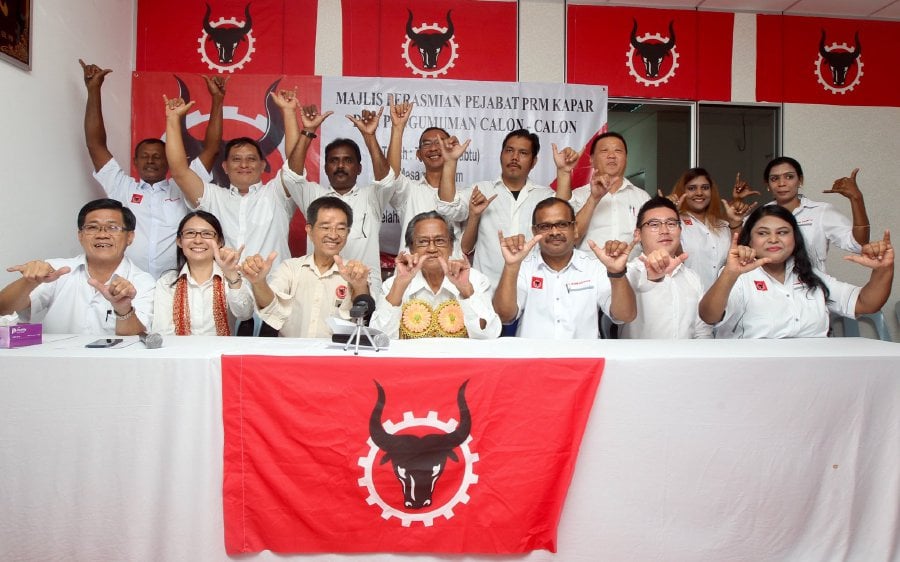
KAPAR: S. Manikavasagam (pix) today announced he was joining Parti Rakyat Malaysia (PRM) and would contest in the Kapar parliamentary seat and take on PKR, the party he left just two days ago.

Making the announcement at a press conference here, the former PKR supreme council member said he had been mistreated by his former party which led him to his resignation.

Manikavasagam, who was Kapar MP from 2008 to 2013 under the PKR banner, was suspended by the party in August last year for two years for allegedly slandering party de facto leader Datuk Seri Anwar Ibrahim at a speech in a temple here last April.

He claimed he was framed by another PKR leader Dr Xavier Jayakumar, saying he had never uttered those words, and that he did not receive any response from the party over his appeal since.

"Xavier lodged the report to PKR, but he was not even in the temple. Because of him I was suspended. So I'm challenging him to stand in Kapar against me.

"Be it him or (incumbent Kapar MP) G. Manivannan, I have no problem. What's important is Indians should never vote for him (Xavier)," he said.

Pakatan Harapan (PH) has allocated the Kapar parliamentary seat to PKR for the 14th General Election.

Manikavasagam, who was also formerly PKR Kuala Selangor division chief, rejoins PRM, a party he first joined in 1999 before leaving for PKR in 2000, saying: "I'm leaving all my positions in PKR to serve the people under PRM."

He said he had also decided to leave PKR following its decision to accept Tun Dr Mahathir Mohamad to lead the Pakatan Harapan coalition and be named as Prime Minister candidate.

"Tun was the reason why many Indians here did not have citizenship, even my mother. She lived here for 60 years, and was still stateless until she died in 2010.

"My family and I, we can never forget this, and we can never accept Mahathir as our leader," he said, adding that he had also been approached by MIC and Parti Sosialis Malaysia (PSM) to join their parties.

Meanwhile, at the press conference, PRM chairman Ariffin Salimon announced that the party would contest in five parliamentary seats and 15 state seats, with Manikavasagam to also stand in the Selat Klang state seat.

He added that future announcements would be made on which seats the party would contest in other states. -Sun Daily, 7/4/2018

PRM to contest 18 state and four parliamentary seats(NST)

Parti Rakyat Malaysia, synonymous with its ‘bull head’ logo, will contest in 18 state seats and four parliamentary seats in the 14th general election. (FIle pix)
 
BUTTERWORTH: Parti Rakyat Malaysia, synonymous with its ‘bull head’ logo, will contest in 18 state seats and four parliamentary seats in the 14th general election.

This was announced by party president Ariffin Salimon, who introduced the candidates to the media, in a ceremony held at a hotel here this morning.

This is one of the party’s major involvements in the general election in Penang since the 1960s.
PRM is also the first party to announce its candidates for the elections in the state.

State PRM chairman Tang Hiang Lye believes the party will make a breakthrough in Penang this time around.

“Many issues in the state are affecting the people and there seem to be no solution at sight."

Meanwhile, Ariffin said the party would contest in 20 parliamentary seats and 80 state seats in the coming elections in four states.

Besides Penang, the other states are Kedah, Selangor and Sabah. - NST, 10/4/2018

PRM to contest 4 parliamentary, 18 state seats in Penang

PRM to contest 4 parliamentary, 18 state seats in Penang

 | April 10, 2018 
 
Most of the seats are on the mainland, PRM president Ariffin Salimon announced today.

PRM president Ariffin Salimon announced the party’s candidates at a press conference today.

BUTTERWORTH: Parti Rakyat Malaysia (PRM) will be contesting four parliamentary seats and 18 state seats in Penang in the 14th general election (GE14).

This was announced by its president Ariffin Salimon in a press conference here today.

The four candidates for the parliamentary constituencies are Azman Shah Othman, who will contest in Tasek Gelugor, Tan Lay Hock (Bagan), Tan Hiang Lye (Batu Kawan) and Samsuddin Yacob (Nibong Tebal).

All four constituencies are on the mainland.

The same candidates will also be contesting in state seats under the respective parliamentary constituencies, with Azman to contest in Permatang Berangan, Lay Hock in Sungai Puyu, Hiang Lye in Bukit Tengah and Samsuddin in Sungai Acheh.

Two former journalists, Chua Cheong Wee and Chew Seng Tung, will be fielded in the Tanjung Bungah and Pengkalan Kota state seats respectively. Both constituencies are on Penang island.

Former Kedah PKR exco Tan Chow Kang will contest in Sungai Bakap, located on the mainland.
PRM will also field candidates in the following state seats: Penaga, Telok Ayer Tawar, Bagan Dalam, Bagan Jermal, Berapit, Machang Bubuk, Padang Lalang, Perai, Bukit Tambun, Jawi and Bayan Lepas.

PRM previously announced its intention to be a third force in Penang as it attempts a comeback following a long political hiatus.

Its former state president Gary GV Nair recently filed a complaint with the Registrar of Societies (RoS), claiming there had been a breach of the party’s constitution.

He also claimed that decisions were made without the support of party members.

Gary, who is still a PRM member, alleged that the plans to field candidates in GE14 had not been discussed with PRM members and were not supported by the majority of members.- FMT, 10/4/2018